She was four days into a journey that had started in Mumbai, and the university was closed. It was January in St. Louis, the middle of a snowstorm. She was wearing a cotton salwar kameez and open slippers. She had two suitcases, a hundred dollars, scholarships that covered one semester of tuition, and, by her own account, a plan to go back home as soon as the degree was finished.
A student she met at the airport offered her a ride. When the student realized the young woman from India had nowhere to go, she let her stay on the front porch of her apartment. “I had traveled halfway across the world to get an education,” Sheroo Mukhtiar told a roomful of Houstonians on a Thursday morning in October. “Within days, I was sleeping on a stranger’s porch, surrounded by snow.”
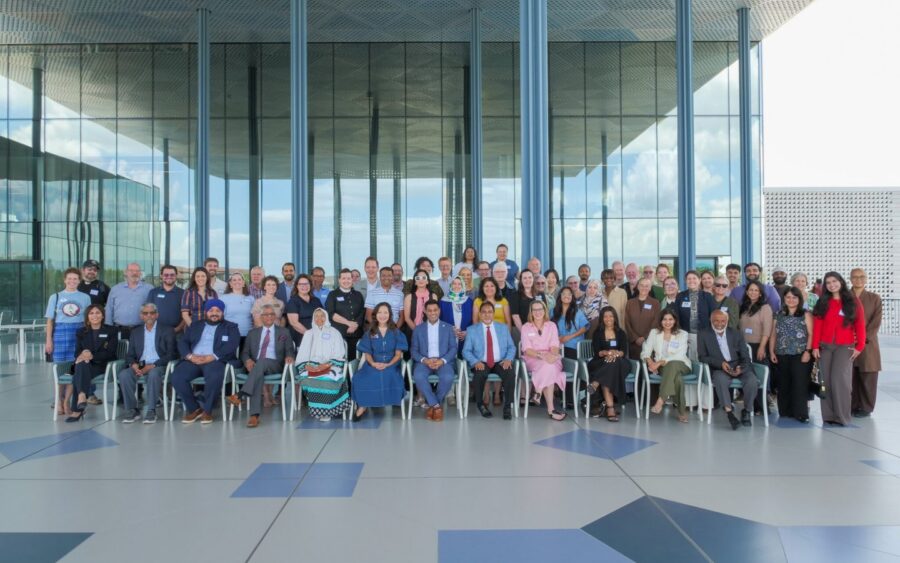
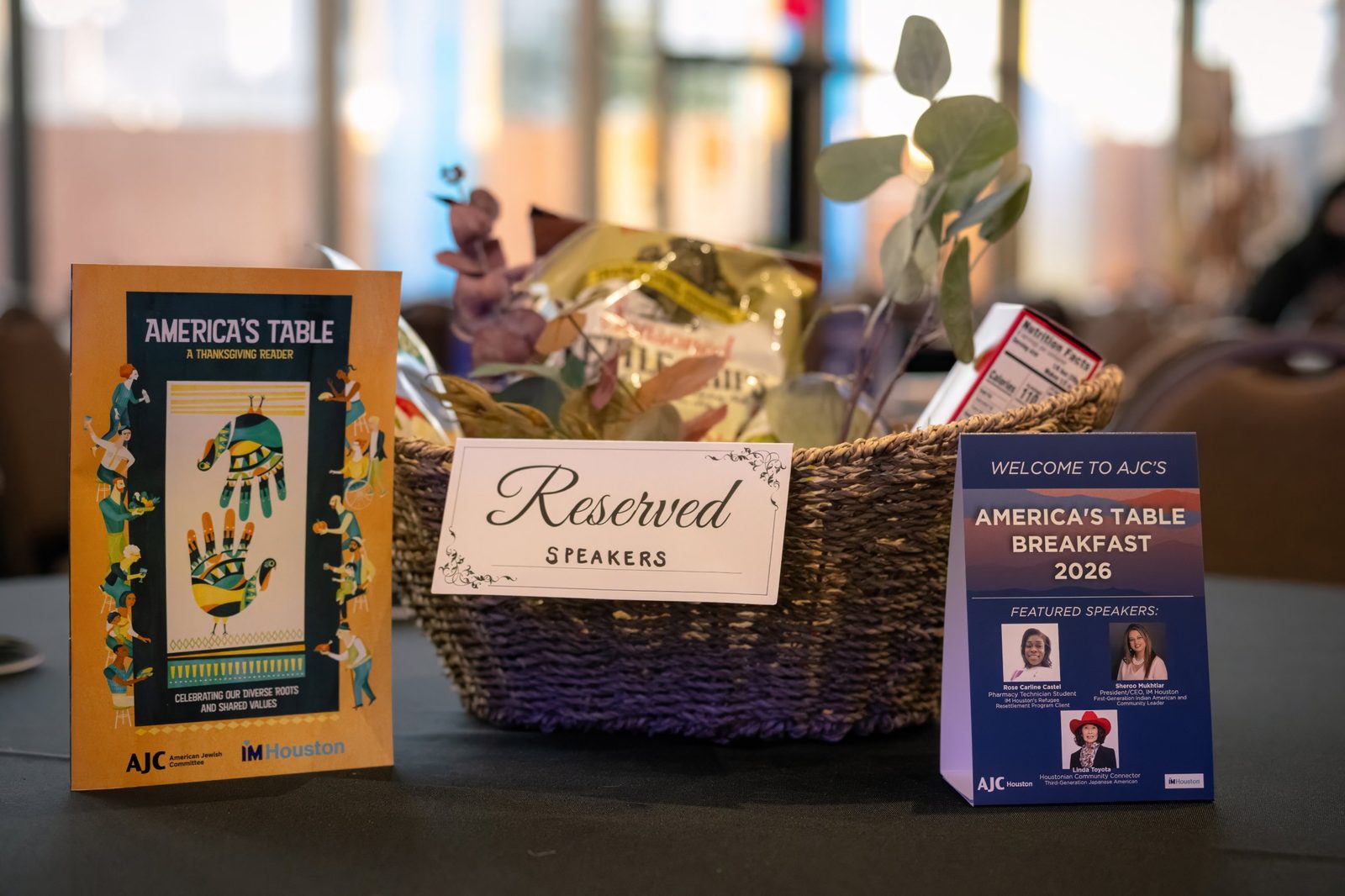
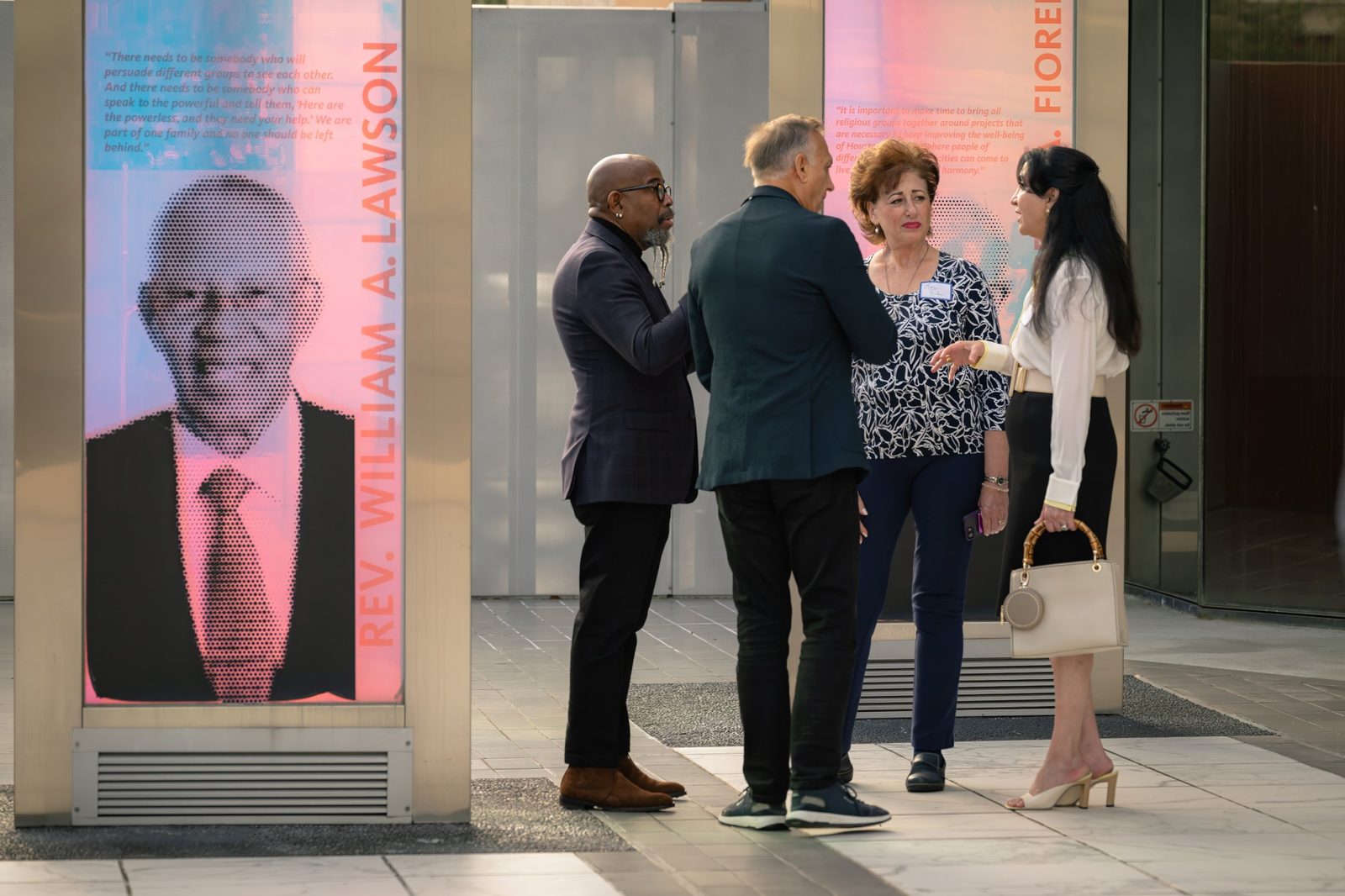
The room was our Great Hall. The occasion was America’s Table, the annual breakfast AJC Houston created in the aftermath of Sept. 11, 2001, and brought to IM Houston this year. The morning’s question was what it means to find home. Three Houstonians were there to answer it. Mukhtiar, now president and CEO of IM Houston, went last. She did not open with her title.
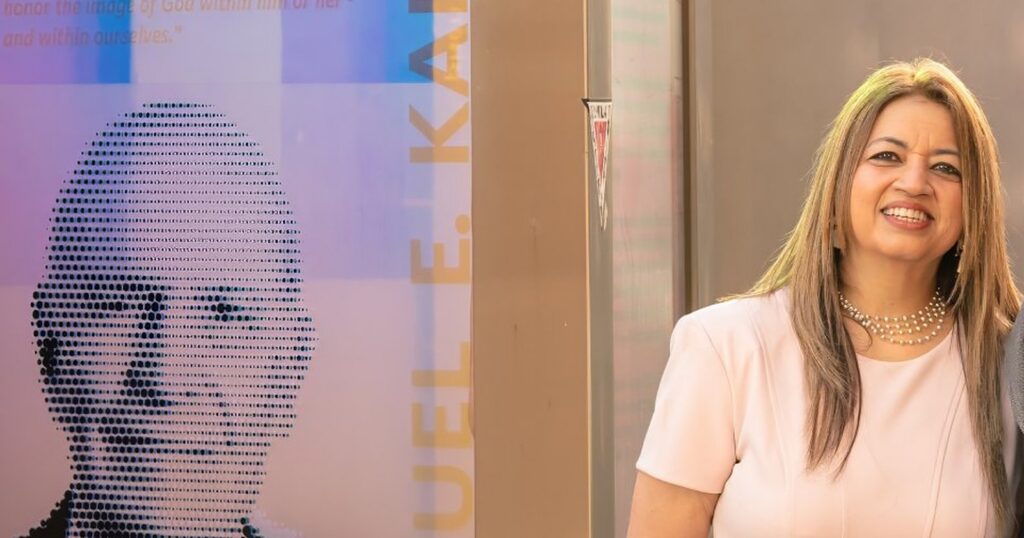
“My American story is a story of love. The love that I brought with me, the love I found here.”
Sheroo Mukhtiar
The childhood that made interfaith ordinary
Long before the snowstorm, there was a Jesuit school in Mumbai and a girl sitting among classmates of many faiths.
“We prayed differently, but shared food, entered one another’s homes, and celebrated many cultures and traditions. I didn’t know words like interfaith dialogue or religious pluralism. I just knew that these were people I loved.”
That sentence is worth sitting with, because it describes the thing IM Houston spends its days trying to engineer. Her father was an automobile engineer and, in her telling, her hero. Her mother was a seamstress who “stitched together a life for us that continues to teach me the power of faith and resilience.” The two of them took her along when they volunteered, which she credits with pointing her toward the nonprofit sector. The dream she built out of it required a master’s degree and an ocean crossing.
“But a dream also needs people to make it real,” she said. A teacher, a woman of Zoroastrian faith, helped her find a way. Public and private foundations supplied financial support, including a one-way plane ticket.
The people who opened doors
Three days after the airport, she carried her suitcases through melting snow to the campus international office. Waiting there was a man she had never met but had been writing to by hand for more than two years, letters crossing the Arabian Sea and back while she applied, waited and planned.
“He was the only person in this country who knew my name.”
Sheroo Mukhtiar
He gave her the first real meal she had eaten in a week. He let her call her parents so they could hear her voice and know she was safe. Then he helped her find somewhere to live: the corner of a crowded, cockroach-infested apartment, with a window sill for a closet. “The rent of one hundred dollars a month included one hot meal,” she said. “I gladly said yes.”
For the next two and a half years she worked the campus library and the bookstore, took an off-campus job caring for a Jewish family’s newborn, rode public transportation everywhere and carried a full course load. The campus church and the campus synagogue, she said, “welcomed us for meals every week.” “And although I was grateful,” she added, “I was never sure what the next day would bring.” It is at this point in the story that she stopped narrating and turned to the room.
“That is the person I hope you will remember when you hear the word immigrants. Too often we hear an argument, a statistic, a policy debate. Today I hope you see the person, someone with a family, ambition, and something to give, if given a chance.”
The family she found
The next turn in her life came from a free lunch. Before graduation, she volunteered as a server at a job fair because the shift included food. While she was pouring coffee for recruiters, she got to talking with people from Boys Town, the Omaha organization that works with children and families in crisis. They offered her a job, medical insurance, help moving to Nebraska and a work permit. “A ten-month commitment turned into ten years,” she said. “My Boys Town family became my American family.”
They vetted her future husband during the family’s arranged marriage process. They threw her a wedding shower. They welcomed her baby. “I had arrived in this country with no one waiting for me,” she said, “and now there were people celebrating the milestones of my life.” After Sept. 11, threats against her family sent them back to St. Louis. There the Franciscan Sisters of Mary handed her the first executive leadership role of her career: a transitional housing program for homeless teenage mothers, some as young as 12, and their babies.
She described the fit without a trace of self-congratulation.
“After all, I knew something about needing shelter and wanting someone to see your potential beyond your surface canvas.”
Through all of it, she said, her husband has been “my quiet strength, my voice of reason, and my best friend. And together, we built a life.” His job brought them to Houston almost 14 years ago. “Today, it is our home,” she said, “and although it took some getting used to, we would never trade Houston for any other place in the world.”
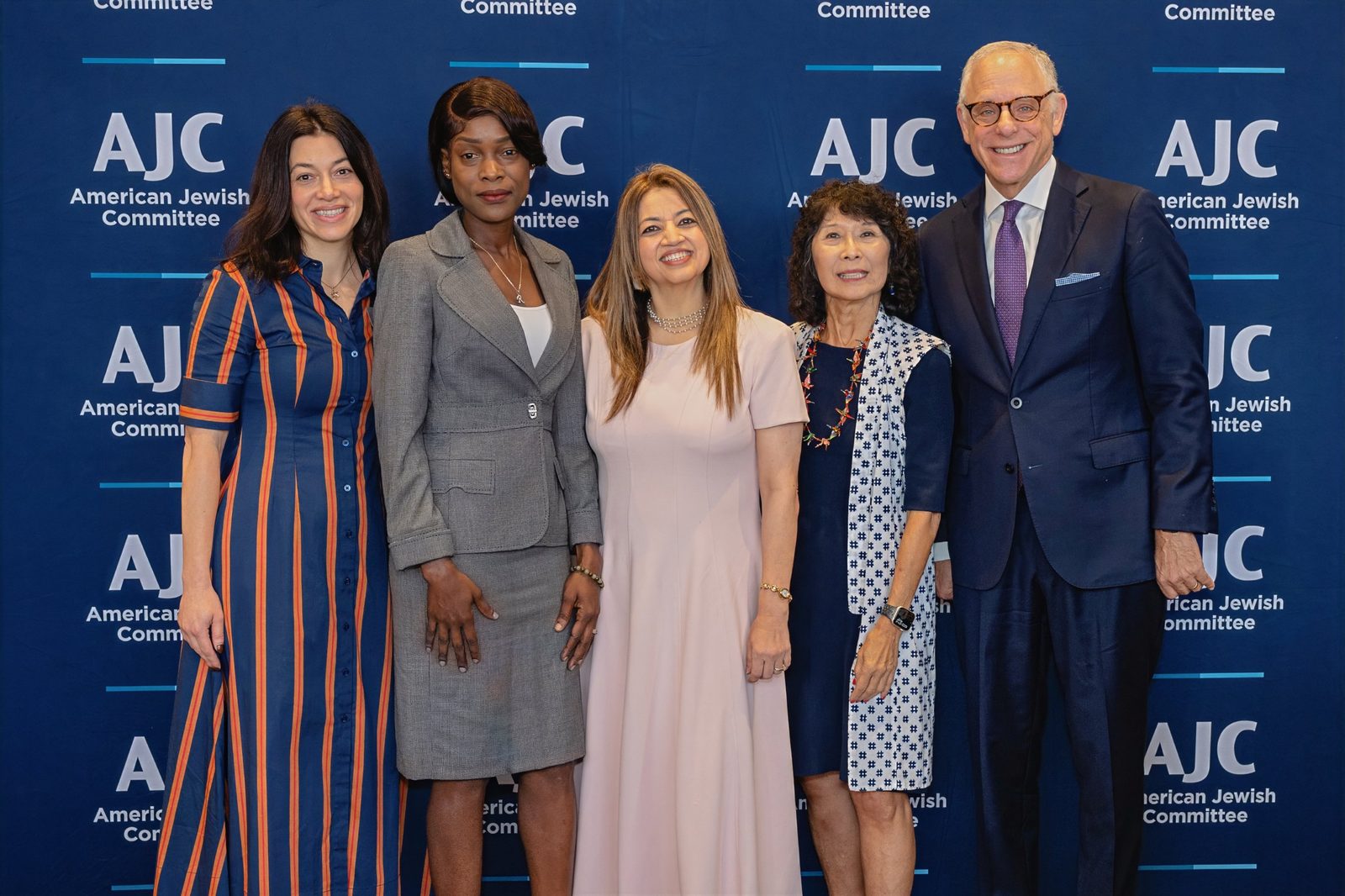
Photo: Lynn Pennington Photography
Why this work
When IM Houston came along, she said, something in it registered before she could have explained why. “I felt drawn to this organization long before I fully understood its work.” Then she accounted for it, and the accounting is the closest thing to a mission statement the morning produced.
“The child raised among many faiths, the newcomer who needed a welcome, the student who depended on someone for a meal. Every part of this journey, I believe, was preparing me for this work.”
Sheroo Mukhtiar
Later she laid it out program by program, though she never used the word program.
“When we deliver meals, I remember hunger. When we welcome refugees, I recognize the uncertainty of arriving somewhere unfamiliar, hoping someone will help you find your footing. When we connect volunteers with neighbors, I remember what it means when someone chooses to show up. And when we bring different faith communities together to learn and serve, I see the possibility I knew as a child.”
Four sentences. Meals on Wheels, Refugee Services, Volunteer Houston, Interfaith Relations. There is not an abstraction in the list. “We can do these things together,” she said, “even when we disagree.”
What a label costs
She had one more argument to make, and she made it carefully.
“We live in a world that categorizes us. Jewish, Muslim, Christian, Hindu, Sikh. Immigrant, native-born, Republican, Democrat, liberal, conservative. Once we reduce someone to a label, it becomes easier to stop seeing the person. Easier to stop caring about what happens to them.”
Then she set her own life against the categories, and she did it in the third person, as though the young woman on the porch were someone she had once watched from a distance. A Parsi teacher. Public and private foundations. “A Baptist advisor fed her. A Jewish family trusted her with their newborn. Catholic nuns entrusted her with her first executive leadership role. An organization founded to serve the Hispanic community welcomed a CEO that did not speak Spanish.”
No single community carried her. All of them did, in pieces, over decades. Not one of them asked her to stop being who she already was.
“That is the America I know. The America that gave me reasons to stay. Where you don’t have to give up who you are to belong. Where my faith doesn’t diminish yours. Where your story doesn’t threaten mine. Where we can disagree and still love and respect one another. And where someone who arrived yesterday can help shape our shared future.”
The room had gone quiet by then. Breakfast was finished. The AJC readers were still open on the tables.
Photo: Lynn Pennington Photography
“I arrived in America with two suitcases and a plan to go home. I never imagined how many people would help me build one here.”
Sheroo Mukhtiar
Our thanks to AJC Houston for choosing IM Houston as its partner for this year’s America’s Table, and for spending the morning in our Great Hall.