
Not a job. Not an apartment. A way in.
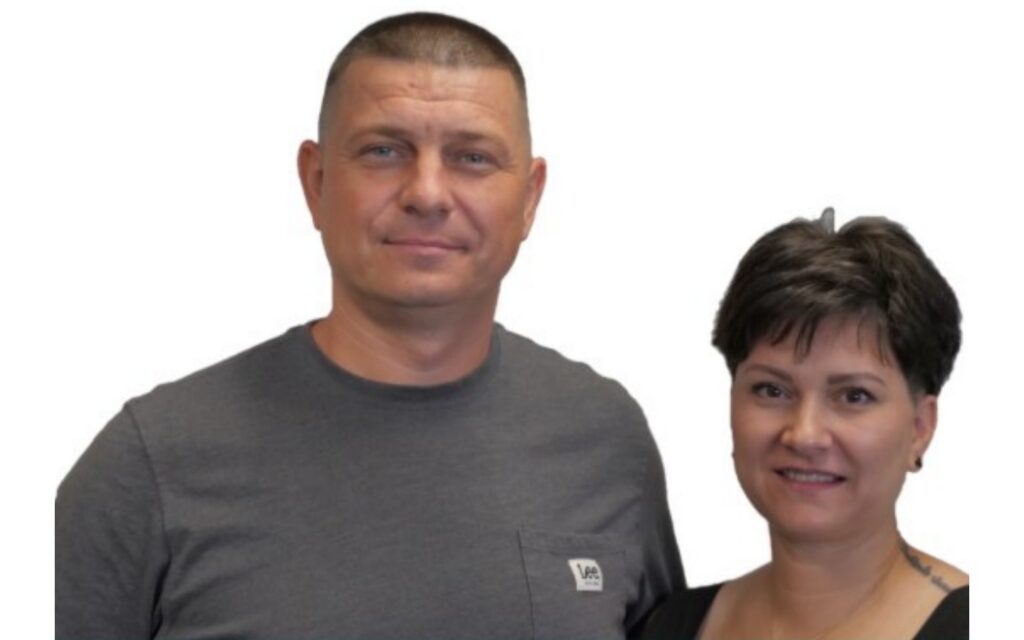
She and her husband, Denys, had left a good life to go looking for one. In Ukraine they had three children, a company they had built and run for four years, and a trade they had both spent their working lives on.
“We have a big family. We have three children,” Yuliia said. “In Ukraine we had a happy life.”
Denys started working for himself early. “I am from such a region of Ukraine where entrepreneurship was nothing supernatural,” he said. “Since I was young, I have been trying to improve myself.”
Since Russia’s full-scale invasion in February 2022, 5.86 million Ukrainians have been recorded as refugees, most of them still in Europe. Another 3.7 million remain displaced inside Ukraine’s own borders. Behind each of those numbers is a family deciding, more than once, where to go next.
Three decisions
Yuliia and Denys decided three times. Eight months in one country. Then Canada, which they left because they wanted somewhere warmer. Then a short list of what they actually wanted: an industrial city with work in it, a warm climate, and the sense that a community would make room for them.
They chose Houston, and they have never regretted it.
The language was the first difficulty, and they had expected that. What they had not expected was that the language would not be the hardest part. The hardest part was the thing Yuliia had to find a word for.
It came, as these things do, sideways.
“As always, it happens through networking,” she said. “Right at the time when we were looking, looking for that bridge. And naturally, when you are looking for something, you find it.”
They met a woman named Liza, who mentioned that she worked with IM Houston. They found common ground quickly. This, they decided, was what they had been looking for.
IM Houston could not give them a business. What it gave them was the crossing, from arriving to belonging, and from belonging to building something of their own.
What they built
After that, they looked at Houston the way tradespeople look at a city.
“Appliances always break down. They always need repair,” Denys said. “Economically that is sound. You will always have work. And Houston is a growing city. The number of houses keeps increasing.”
They called the company SpeedFix.
Anyone can sell a replacement. SpeedFix was built on something harder, and Yuliia is the one who can say what it is.
“Our professional work is aimed at helping families save money, because the most important thing is professional diagnosis. That is where everything starts,” she said. “If a unit can be repaired, it should not drain a family’s money. It should go on living, instead of going straight to the landfill.”
Denys is the one who holds that line in the field. He carries an EPA certification, and he does not start with the symptom, because a “guess dressed up as an answer is how a family ends up buying a machine it did not need.” If an appliance can be repaired, he repairs it. If a repair is not worth what it would cost, he says so plainly and leaves without the job.
It costs them work. They do it anyway.
“Our most important goal is to convey to people that repair is not scary,” Yuliia said.
Staying able to say that takes effort. “Machines are becoming more complex, the electrical components and the mechanical ones both,” she said, “so we have to keep developing and keep learning.”
They divide the company between them. “Denys is responsible for the vision of the business, where we are moving,” Yuliia said. He does the field work and backs up the other technicians. She takes the customers, the marketing, the systems and the subcontractors, and she is the one in the room when the company talks to anyone about what it might become next.
In roughly a year, they have worked for about 500 customers, and more than 100 of them wrote reviews afterward. A used-appliance chain is in talks with them about becoming its service partner. They would like to open branches. Denys would like, eventually, to hand his children something worth continuing.
“The first year is the hardest,” he said, “because we are still migrants, still learning the language, and still learning how the American market is built. Now I understand clearly that we have come through that stage.”
What they would tell someone who arrived last week
Asked what they would say to someone who arrived last week, neither of them mentioned paperwork, or jobs, or any of the things that fill the first months.
“Set a goal,” Yuliia said. “Then look for the direction where it will be interesting to show yourself.”
Denys put it more simply.
“Do not be afraid of people. Even without the language, we can understand one another. Go, give that help, receive that help.”
Support Refugee Services
Refugee Services walks with newly arrived families through resettlement, employment, legal services and the first years of building a life here.